Patina vs
Performance
The Philosophical Divide — Patina vs. Performance
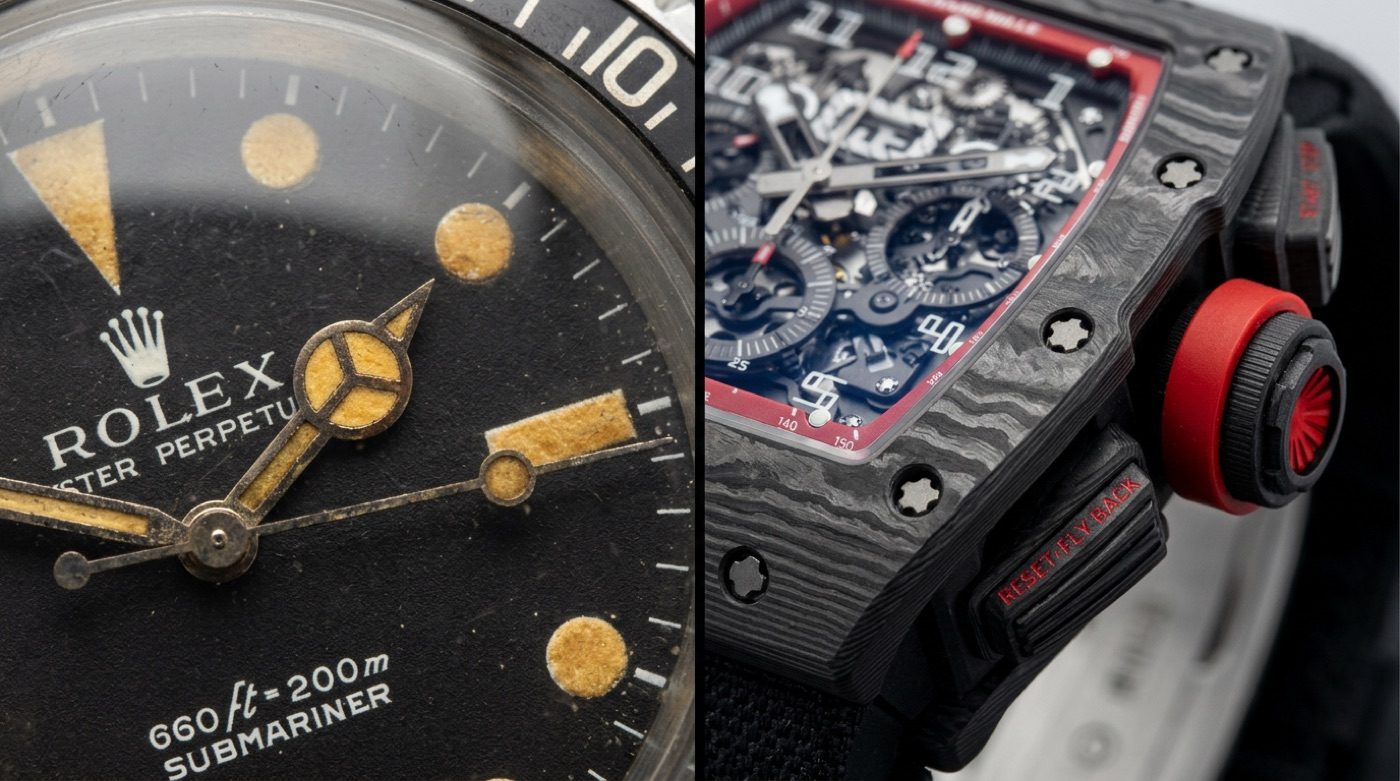
At the apex of the 2026 horological market, capital allocation decisions are increasingly shaped by a clear philosophical divide. Investors must choose between two distinct value systems: historical provenance and artisanal depth on one side, and apex technology and engineered performance on the other. Both paths deliver million-dollar valuations, yet they rest on fundamentally different foundations. For family offices and high-net-worth allocators, this choice is not about personal taste. It is a strategic asset allocation decision that aligns with specific risk profiles, time horizons, and signaling objectives in an environment where technical perfection is increasingly accessible through automation.
The Custodian Approach: Investing in Historical Provenance and Non-Replicable History
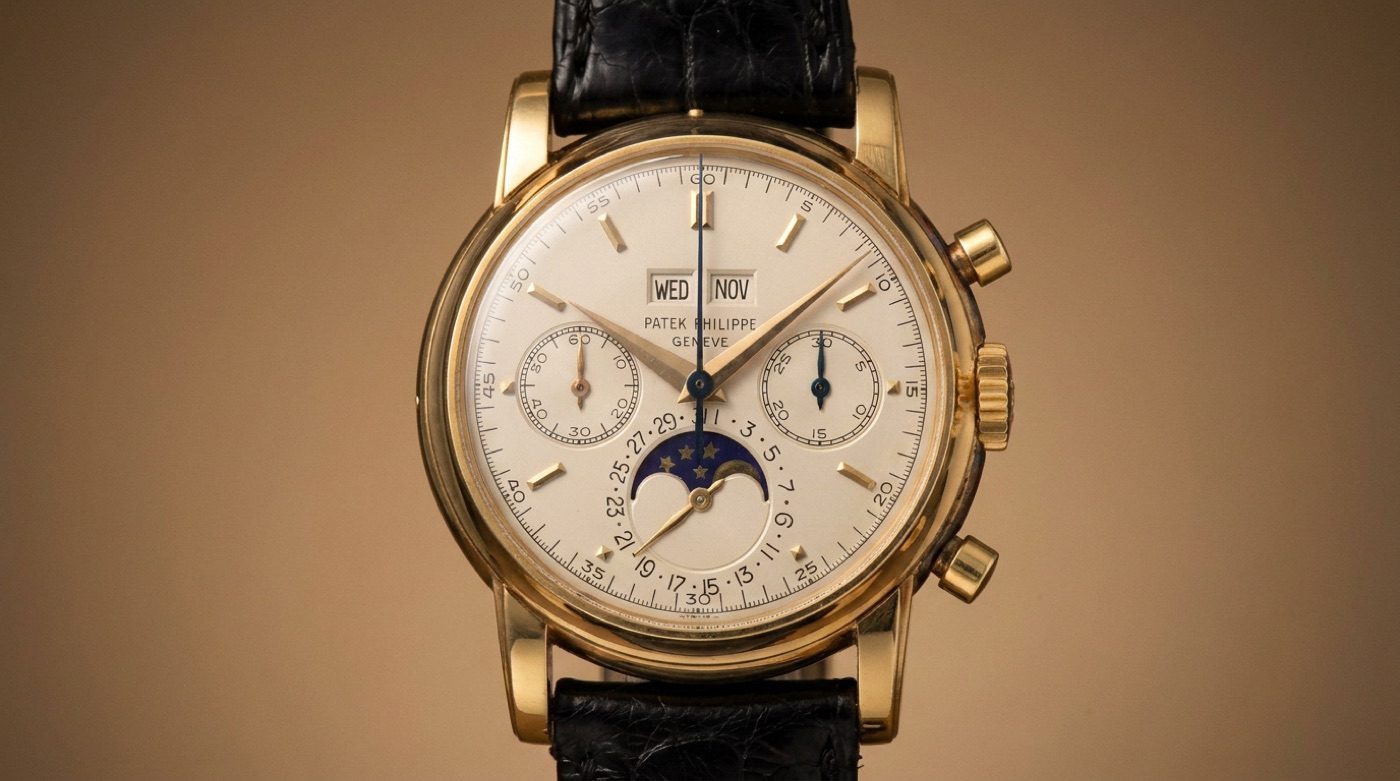
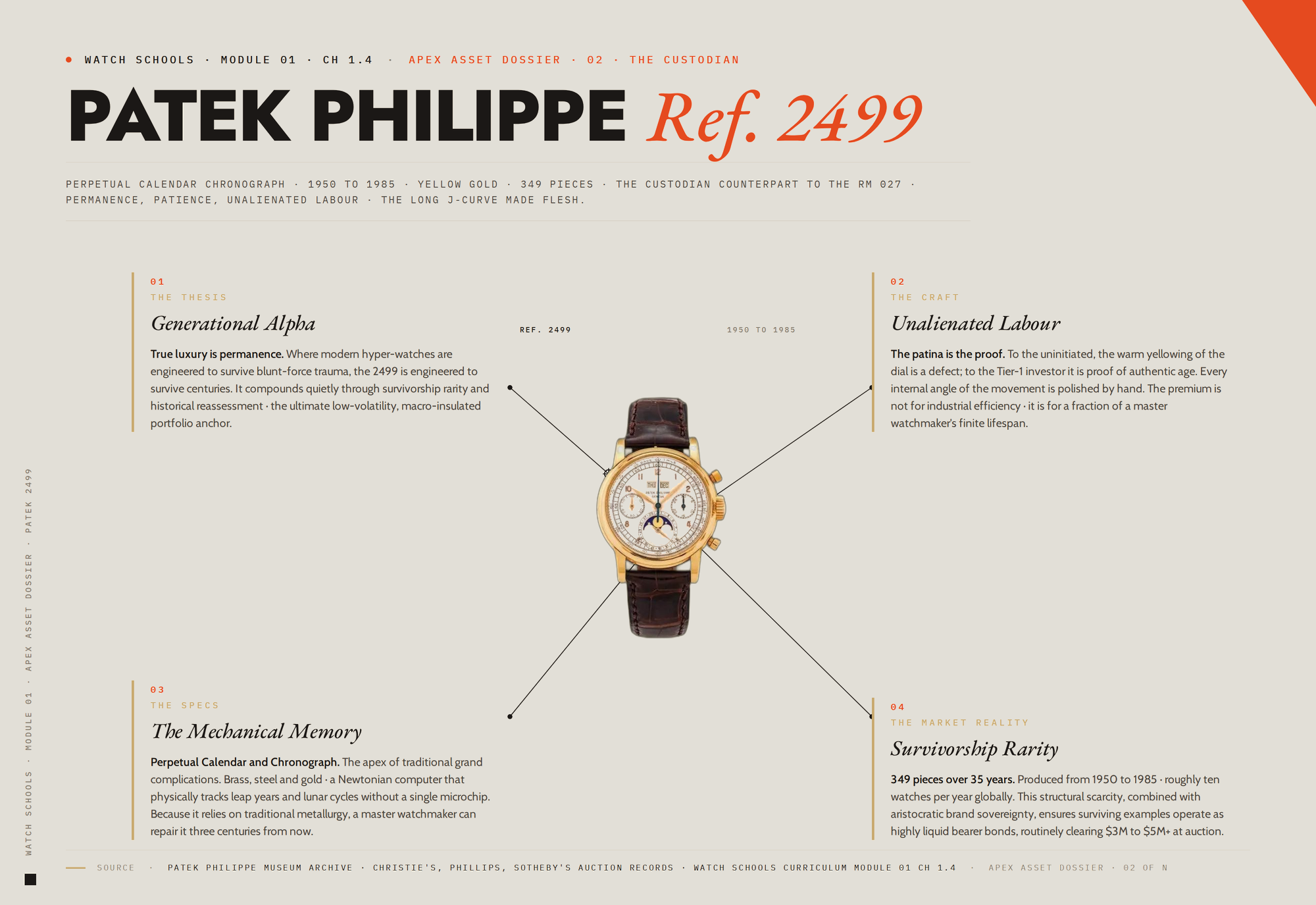
Investors who favour vintage mechanical watches, particularly those from houses such as Patek Philippe, act as custodians of established value. Their capital is directed toward pieces defined by patina, documented history, and the evidence of irreplaceable human effort. In this segment, natural ageing and subtle imperfections are not liabilities; they are the primary value drivers. One caveat: skilled counterfeiters today can replicate convincing patina, particularly on tropical dials. The market still rewards authenticity, but authentication has become a more demanding discipline. A faded tropical dial or the soft oxidation of luminous material on a 1960s reference serves as tangible proof that the watch has survived decades of real-world use while retaining its original character.
This approach emphasises non-replicable history. Vintage pieces are built from traditional materials such as brass and steel that allow for ongoing restoration by skilled hands. Their architecture is based on Newtonian principles that have remained stable for generations, offering a form of permanence that supports long-term capital preservation. Family offices often view these watches as low-volatility holdings because their appeal rests on factors that cannot be duplicated by modern manufacturing processes. The investor is not purchasing a timekeeping instrument alone. They are acquiring a physical record of craftsmanship and continuity that provides a stable store of value across market cycles. A longer-horizon thesis worth acknowledging here: dials are, in essence, discs of brass with paint applied to them. Over decades, that paint will continue to corrode — eventually, in many cases, to nothing. Either the vintage market will need to learn to accept beautifully restored dials, or these watches will lose much of their value. A pristine original dial from the 1950s today will likely require restoration a century from now. At Watch Schools, our view is that a substantial market realignment is coming: vintage watches will increasingly be valued by rarity of model rather than rarity of dial configuration.
The Disruptor Approach: Investing in Apex Technology and Total Resource Coordination
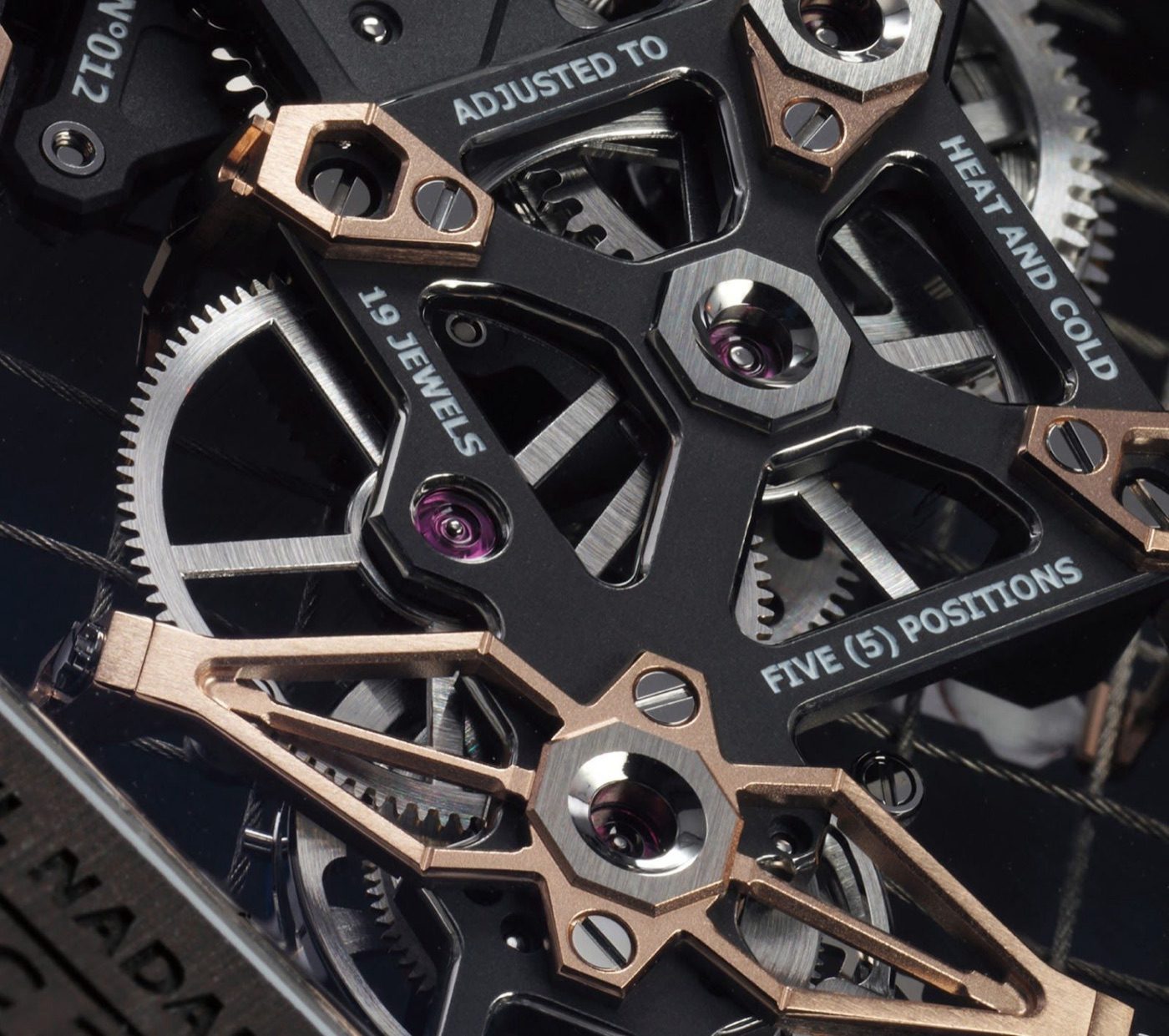
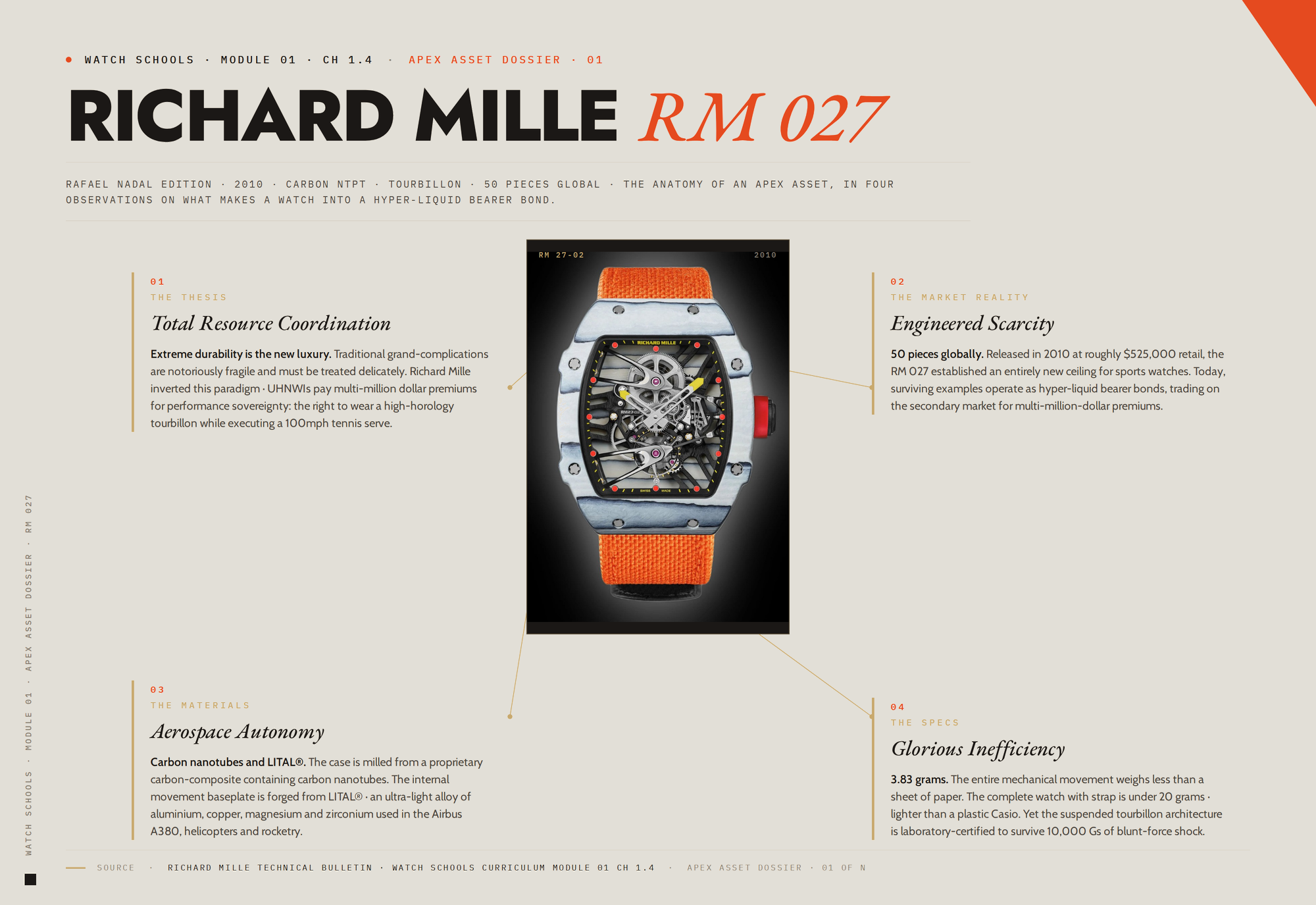
At the other end of the spectrum are investors who pursue modern high-tech watches, led by houses such as Richard Mille. These allocators prioritise systemic mastery and process rarity. Value here derives from the coordinated application of advanced materials science, laboratory testing, and engineering at the limits of what is physically possible. Traditional gold and steel are replaced by Grade 5 titanium, carbon TPT composites, and other aerospace-derived substances engineered for extreme shock resistance and minimal weight.
The scarcity in this category is structural rather than artificial. Producing a single Carbon TPT case involves weaving carbon layers at precise angles under high pressure, a process that generates high scrap rates and destroys tooling. The investor pays for the extensive research and development infrastructure required to bring Formula 1-level technology to the wrist. These watches deliver verifiable performance advantages, such as surviving forces measured in thousands of g that appeal to clients who value technical supremacy and forward-looking innovation. For family offices focused on the next generation, this path signals alignment with disruption and the ability to command the future rather than preserve the past. An underestimated dimension of this disruptor thesis is generational fantasy. People tend to want to own, in adulthood, the cars and watches that hung as pin-ups on their bedroom walls in childhood. The children who grew up with Richard Mille will be the adults reaching for it in two decades. A useful cautionary parallel is antique furniture: Georgian furniture is now effectively defunct as a market, because the next generation does not want it. This raises a real question for vintage 1940s/50s Patek Philippes, Rolexes and APs: what will they truly be worth, twenty years out, if the next generation of capital is interested only in the contemporary?
Comparing the Two Paths: Risk Profiles and Signalling Objectives
Despite their differences, both vintage provenance and apex technology serve the same underlying purpose in elite circles: they provide a credible signal of financial sovereignty that is recognised by peers. The choice between them depends on the investor’s risk profile and signalling needs.
The custodian path offers lower volatility and stronger capital preservation characteristics. Its value is anchored in historical continuity and the difficulty of replicating authentic patina or documented provenance. These pieces tend to perform well in periods when the market favours stability and established narratives. They are often seen as a hedge against the commoditisation of technical features through automation.
The disruptor path carries higher short-term price sensitivity tied to technological trends and brand innovation cycles, but it appeals to clients who seek to project technical leadership. These watches demonstrate the owner’s engagement with the most advanced manufacturing capabilities available and can command strong demand among younger high-net-worth individuals who view them as wearable evidence of alignment with the future.
Investor Guidance: Choosing the Right Allocation
Family offices must evaluate their objectives clearly. Those prioritising long-term stability and resistance to replication often allocate to historical provenance, where value is protected by non-replicable stories and human craftsmanship. Those seeking to signal innovation and technical competence allocate to apex technology, where value is driven by process rarity and verifiable engineering performance.
Both strategies have proven effective in the 2026 market. The key is alignment: vintage pieces reward patience and deep research into history, while high-tech pieces reward an understanding of materials science and manufacturing limits. In either case, the mechanical watch functions as a deliberate allocation rather than a simple purchase. It serves as a portable, high-density asset that communicates competence, intentionality, and control in a world where many forms of wealth have become weightless and easily replicated.
To understand the practical implications of this alignment, one must examine the distinct valuation trajectories these two strategies generate. While both classes provide extraordinary returns, they arrive at those valuations through completely different economic mechanics. The vintage market operates on "Generational Alpha," where value compounds slowly over decades before entering an exponential "J-Curve" driven by survivorship rarity and historical reassessment. Conversely, the modern high-tech market operates on "Liquidity Alpha." Because the scarcity is engineered at the point of production through restricted allocations, the valuation curve resembles an immediate "step-function", skyrocketing the moment the asset leaves the boutique and hits the secondary market.
This structural divergence highlights why "taste" is a serious financial posture. The investor who acquires a vintage artifact is playing a long-term game of Information Asymmetry, banking on the fact that true history cannot be CNC-machined. The investor acquiring a modern hyper-watch is executing a high-velocity liquidity play, utilizing the watch as a frictionless bearer bond that capitalizes on the immediate, global demand for visible, systemic dominance.
The philosophical divide is ultimately a practical framework for portfolio construction. Selecting between patina and performance is selecting between two proven forms of sovereignty, one rooted in the past and one oriented toward the future, each offering distinct advantages in risk management and peer recognition. The mechanical watch on the wrist remains one of the most efficient vehicles for expressing and preserving capital in an increasingly complex financial landscape.